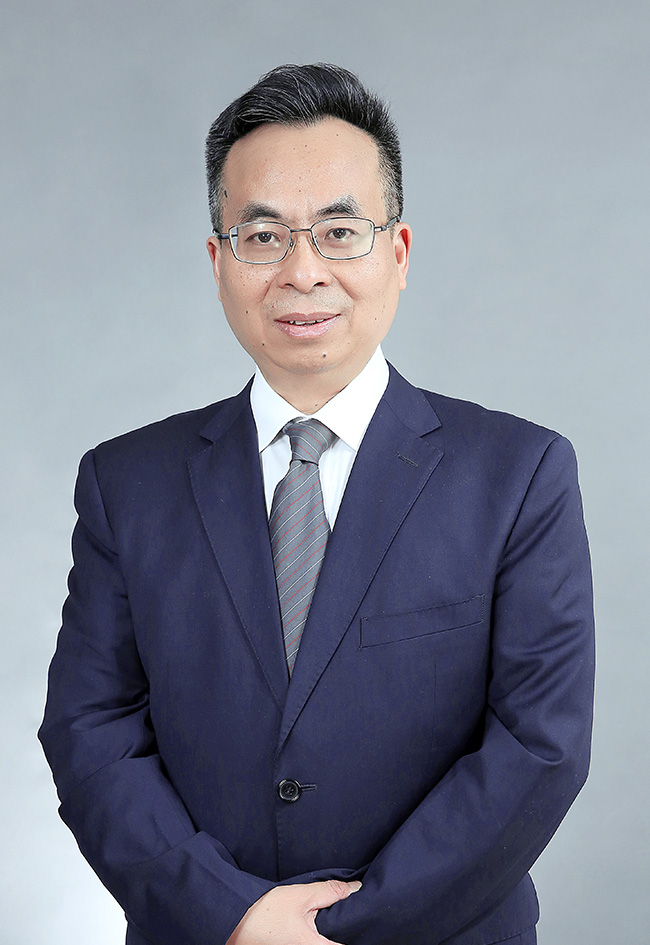
Prof. Hong Liu is the Party Secretary of the Chongqing Institute of Green and Intelligent Technology(CIGIT), Chinese Academy of Sciences(CAS) and a Professor in Environmental Engineering at the College of Resources and Environment, University of Chinese Academy of Science in Chongqing.
He received his B.S. degree in Environmental Science from Southwest University (1989-1993), M.S. degree in Environmental Chemistry and Ph.D. in Physical Chemistry from Zhejiang University (1993-1999). Prior to joining CIGIT in 2011, He worked as a Postdoctoral Research Fellow in Dalian Institute of Chemical Physics, CAS (1999-2001) and The Hong Kong Polytechnic University (2001-2003). He was appointed as an Associate Professor and promoted to a Professor in Sun Yat-Sen University (2003-2011).
Prof. Hong Liu is selected a committee member of The 9th Expert Advisory Committee of the Ministry of Engineering and Materials Science, National Natural Science Foundation of China.
He has secured over 30 national, provincial and industrial grants, such as the National Science Fund for Distinguished Young Scholars and the National Key Scientific Instrument and Equipment Development Project. Moreover, he has authored more than 200 refereed journal publications and 5 monographs and granted 57 Chinese patents, 3 International patents and 10 copy rights of softwares . He received the First Prize of Natural Science in Guangdong Province, the Second Prize of Natural Science in Chongqing. the First Prize of Excellent Demonstration for Environmental Protection Technology in Chongqing, and First Prize in Environmental Science and Technology Award.
He has extensive experience with both theoretical and applied electrochemistry. More specifically, his research program mainly explores the principles and methods for intelligent control of electron transfer during the organic contaminant degradation in wastewater. Previous work on dynamic and mass transfer simulation for dissolved oxygen and charged particles in electrode interface helped him to establish the fundamentals of Environmental Electrochemistry for wastewater treatment. In addition, he came up with the latest microbial colometry to develop BOD-Q water quality analyzer, which broke through the bottleneck in the intelligent monitoring system for organic wastewater treatment and established the electrochemical principle and method for online analysis of microbial electron signal. Besides, he developed the hybrid microbial-photoelectrocatalytic process for high-concentration organic wastewater and diagnostic model about rate-limiting step in complex photoelectrocatalytic degradation for toxic organic contaminants, which established the theoretical and practical method of in situ electrocatalytic generation, identification and regulation for highly reactive oxides.

