Matrix Magic Cube for Physicochemical Knowledge Representation of Biological Nitrogen Removal Processes — Process Descriptor
2026-05-27 16:34:00
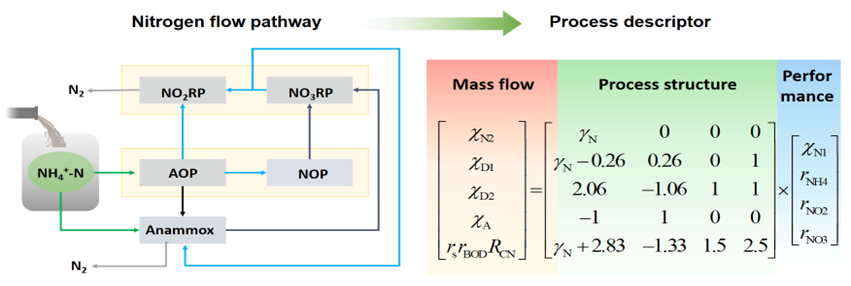
The primary form of physicochemical knowledge representation for wastewater treatment is the Activated Sludge Model (ASM) series. These models employ matrix tabular representations to describe biochemical processes and material interactions, essentially consisting of kinetic differential equations and stoichiometric relationships governing material transformations. Model implementation demands strong professional expertise and programming proficiency, creating a high knowledge barrier that hinders integrated applications with artificial intelligence, control science, and related disciplines. To address this challenge, Dr. Yin Fengjun, a researcher at the center, published the academic paper "Developing process descriptor for biological nitrogen removal in wastewater treatment" in Water Research. This work introduces the novel concept of a process descriptor, which converts the stoichiometric causal relationships of BNR processes into a structured matrix form. This enables professionals engaged in process control and modeling to apply the laws of process data in a programmed or purely mathematical manner relying on structured data, without the need to master relevant biochemical professional knowledge.
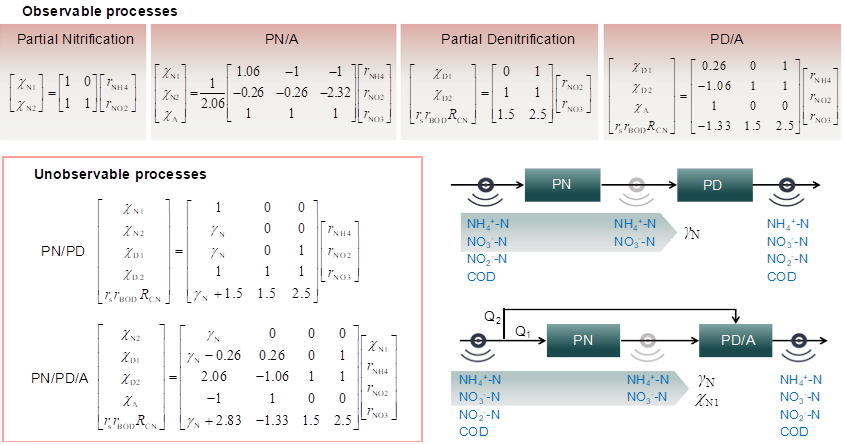
The process descriptor embodies three major values. First, it provides a unified matrix equation tool for describing the stoichiometric relationships of denitrification processes. Matrix description equations for arbitrary combined processes such as partial nitrification, partial denitrification and anammox can be obtained through pure mathematical derivation. Second, the descriptor equations lay a mathematical foundation for process observability analysis, and provide a theoretical basis for the optimal layout of sensors in complex and unobservable BNR processes. Third, by constructing a deterministic parameter mapping space, it greatly reduces the dimension of uncertain relationships that need to be learned by artificial intelligence models.
https://doi.org/10.1016/j.watres.2026.125907

